Are FHA Loans Only for First-Time Home Buyers?
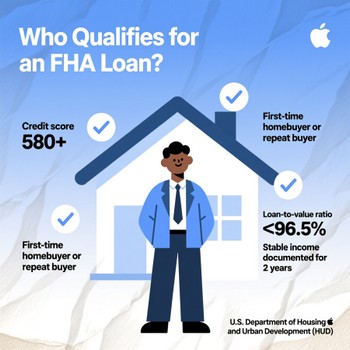 Are FHA loans only for first-time home buyers? This is one of the most common questions I hear, and the answer surprises many people.
FHA loans are not restricted to first-time buyers. Repeat buyers can qualify too, as long as the home will be their primary residence. The program is backed by the Federal Housing Administration, which lowers lender risk and allows more buyers to qualify with flexible credit and down payment requirements.
I have worked with thousands of home buyers, and one mistake stands out: rushing into an FHA loan without understanding its long-term costs. It is not about credit score or savings alone. It is about knowing how mortgage insurance, loan limits, and approval rules affect your monthly payment and your future refinance options.
This guide answers the question directly, then walks through FHA loan requirements, credit score rules, down payment options, mortgage insurance costs, and how FHA compares to conventional loans. No jargon. Just the honest breakdown I wish every buyer had upfront.
Who Qualifies for an FHA Loan?
FHA loans are designed for buyers with imperfect credit or limited down payment funds. They are not limited by buyer status. You do not need to be a first-time home buyer to apply.
Here is who typically qualifies:
- Buyers with credit scores as low as 580 for the 3.5% down payment option
- Buyers with scores between 500 and 579 who can put 10% down
- Repeat buyers who will occupy the home as their primary residence
- Buyers with higher debt-to-income ratios than conventional loans allow
- Buyers using gift funds for the entire down payment
If you have had a bankruptcy or foreclosure in the past, FHA loans may still be an option after waiting periods. A Chapter 7 bankruptcy typically requires a three-year wait. A foreclosure usually requires three years as well. Chapter 13 bankruptcy may require as little as one year with court approval.
For a full breakdown of credit and income rules, see our guide to FHA loan eligibility requirements.
FHA Loan Requirements for First-Time and Repeat Buyers
The requirements are the same whether you are a first-time buyer or a repeat buyer. The FHA does not have a first-time buyer requirement. What matters is the property, your credit, your income, and your debt-to-income ratio.
Here are the core FHA loan requirements:
- Minimum credit score: 580 for 3.5% down; 500 for 10% down
- Minimum down payment: 3.5% for scores of 580 or higher
- Debt-to-income ratio: Typically 43% to 50%, depending on lender
- Primary residence: The home must be your primary residence
- Property condition: The home must meet HUD minimum property requirements
- Appraisal: An FHA appraisal is required and focuses on safety and soundness
Lenders often add their own requirements on top of FHA minimums. Many lenders look for a 620 credit score or higher for smoother approval. Some may require larger down payments or reserves. Always ask your lender about their specific guidelines.
If you are ready to see how your numbers look, try our FHA loan prequalification guide to understand what lenders review before you apply.
FHA Loan Benefits for First-Time Buyers
FHA loans offer several advantages that make them attractive for first-time buyers. These benefits also apply to repeat buyers who need flexibility.
- Low down payment: 3.5% minimum
- Flexible credit requirements: Scores as low as 580
- Gift funds allowed: The entire down payment can be a gift
- Higher debt-to-income ratios accepted: Compared to conventional loans
- Assumable loans: FHA loans may be assumable, which can help in a rising rate environment
Imagine you have saved $25,000. With a conventional loan, you might be limited to modest homes in lower price ranges. With FHA support, that same $25,000 could stretch further, potentially qualifying you for a more expensive home. That flexibility can expand your home selection power.
However, greater buying power also means long-term costs. The key trade-off is qualifying more easily now but paying mortgage insurance over time. You are trading lower upfront requirements for ongoing monthly expenses. Understand the trade before you sign.
FHA Mortgage Insurance Costs Explained
Mortgage insurance is one of the most misunderstood parts of FHA loans. I see buyers overlook it all the time. Every FHA loan includes mortgage insurance, added to each monthly payment.
There are two types of FHA mortgage insurance:
- Upfront mortgage insurance premium (UFMIP): 1.75% of the loan amount, paid at closing
- Annual mortgage insurance premium (MIP): Paid monthly, typically 0.45% to 1.05% of the loan
Here is a real example. On a $300,000 home with 3.5% down, your loan amount would be about $289,500. The upfront premium alone would add roughly $5,066 to your closing costs. That often surprises buyers who have only focused on the down payment.
Then you have the monthly premium. That can easily add $100 to $250 per month, depending on your loan terms.
Here is the catch: unlike conventional loans, FHA mortgage insurance does not automatically disappear at 20 percent equity. For most FHA loans, if you put down less than 10%, mortgage insurance lasts for the life of the loan. The only way out is refinancing into a conventional loan. Even with 10% or more down, you will pay mortgage insurance for at least 11 years.
That is a big deal. Make sure you understand it before you commit. Use our FHA MIP calculator to estimate your monthly and upfront costs.
FHA Credit Score Rules and Lending Standards
The FHA allows lower credit scores than traditional mortgages. But here is what people get wrong: lenders are often stricter than the FHA minimums. The agency might say 500 with 10% down, but most banks will not touch that.
Here are the real-world guidelines most lenders follow:
- Ideal minimum credit score: 580 for 3.5% down
- Acceptable range: 500-579 requires 10% down
- Many lenders look for a score of 620 or higher for smoother approval
Approval depends more on recent credit behavior than the score itself. A 620 with a clean recent history beats a 650 with late payments last month. A clean payment history over the last two years is more important than older financial errors. Lenders want stability, not perfection.
They are searching for patterns. Have you paid your rent on time? Your car loan? Your credit cards? That real behavior matters more than a three-digit number.
If you have had past issues but have been solid for 12 to 24 months, you are in a good spot. If you have recent late payments or collections, it might be worth waiting.
What if my credit score is below 580?
You still have options, but they are more limited. You would likely need a 10% down payment instead of 3.5%. Some smaller lenders and credit unions offer more flexible programs. It is worth shopping around if you are in this range.
But honestly, you might be better off spending six months improving your credit first. A higher score saves you thousands in the long run. Check your credit score for free using our recommended FICO score estimator.
FHA Loan Limits and Borrowing Power
FHA loan limits define the maximum amount you can borrow in each county. These limits vary based on local housing costs. For most of the country, the standard FHA loan limits for 2026 are shown below.
| Single-family | $541,287 |
|---|---|
| Duplex (2 units) | $693,050 |
| Tri-plex (3 units) | $837,700 |
| Four-plex (4 units) | $1,041,125 |
For 2026, the FHA ceiling was set at $1,249,125 for single-family home loans. This represents the maximum amount a borrower can obtain through the FHA loan program in high-cost areas. If you live in an expensive market like San Francisco, New York City, or Washington, D.C., these high-cost limits will apply to you.
But here is what nobody tells you: you cannot automatically qualify for the maximum limit just because it exists. Lenders also look at your debt-to-income ratio. Most FHA lenders require a debt-to-income ratio between 43% and 50%. That means your total monthly debts, including the new mortgage, should not exceed about half your gross monthly income.
A high loan limit is of little use if your monthly income cannot support the payment. Affordability always overrides borrowing ceilings. I have seen buyers qualify for $400,000 but only feel comfortable at $280,000. That is smart. Do not let a high limit trick you into overextending yourself.
Use our FHA loan limit calculator to check the limit for your county.
FHA Loan Application Process and Timeline
FHA loan applications follow a structured approval procedure. Most loans close within 30 to 45 days of application.
Here is the basic timeline you can expect:
- Week 1-2: Application and initial document gathering
- Week 2-3: Lender orders appraisal and begins underwriting
- Week 3-4: Appraisal completed, any conditions requested
- Week 4-6: Final approval and closing
Applicants must provide tax returns, pay stubs, bank statements, and employment records. Missing any of these slows everything down dramatically. Even small issues can delay approval: unexplained deposits, incomplete pages, missing signatures, outdated statements. All of it matters.
My advice? Get every document ready before you even apply. Have two months of bank statements, two years of tax returns, and your last 30 days of pay stubs. Preparation is the single biggest factor for a smooth process. The buyers who have everything ready at day one close two weeks faster than those who do not.
For a step-by-step walkthrough, see our guide on steps to buying a home with an FHA loan.
FHA Appraisal Rules for Home Buyers
FHA appraisals focus heavily on property safety and condition. This is different from a conventional appraisal, which primarily focuses on market value. Homes must meet minimum livability standards called HUD's Minimum Property Requirements. These cover safety, security, and soundness.
What do appraisers actually look for? Here are common deal-breakers:
- Peeling or chipping paint (lead-based paint hazard)
- Missing handrails on stairs
- Cracked or broken windows
- Leaking roofs or visible water damage
- Faulty electrical or plumbing systems
- Evidence of termites or pest infestation
Older homes often require repairs before approval. That $200,000 fixer-upper might seem like a steal, but if the appraisal flags structural issues, the deal could fall apart fast. Sellers are not always willing to make those repairs. And as a buyer, you cannot waive the FHA appraisal or repair requirements. If repairs are not completed before closing, the deal dies.
Property condition directly affects your financing eligibility, sometimes in ways you cannot negotiate around. For more details, see our guide to FHA loan inspection requirements.
FHA vs Conventional Loan Comparison
FHA and conventional loans serve different financial situations. Neither is universally better. It all depends on your specific numbers.
FHA is often better when:
- Your credit score is between 580 and 620
- You have a small down payment (3.5% to 5%)
- You have higher existing debt relative to income
- You have had a past bankruptcy or foreclosure
Conventional loans may be better when:
- Your credit score is 620 or higher (ideally 660+)
- You can put down 5% to 10%
- You want mortgage insurance to drop off automatically once you reach 20% equity
- You plan to stay in the home for many years
The biggest hidden difference is mortgage insurance. With a conventional loan, you can request removal at 20% equity. With an FHA loan, it is usually permanent unless you refinance. Comparing total long-term costs is essential before deciding. Monthly savings today may look great, but lifetime costs might tell a different story.
Run the numbers both ways. A good lender will show you a side-by-side comparison. If they will not, find another lender who will. For a deeper dive, see our comparison of FHA vs conventional mortgages.
FHA Loan Mistakes First-Time Buyers Make
First-time buyers often make emotional financial decisions. I have seen the same mistakes hundreds of times. These mistakes can reduce your long-term economic security. Avoid them, and you will be way ahead of most buyers.
Mistake #1: Shopping with only one lender. Different lenders offer different terms and approval flexibility. Rates vary. Fees vary. Even credit requirements vary. Always compare at least three lenders.
Mistake #2: Borrowing the maximum limit. Just because the bank says you qualify does not mean you should take it. High payments quickly strain monthly budgets. Leave yourself breathing room.
Mistake #3: Ignoring mortgage insurance costs. That $200 monthly premium adds up to $2,400 per year. Over five years, that is $12,000 you could have put toward principal. Plan for the full payment structure.
Mistake #4: Not checking your credit before applying. Pull your credit reports three to six months before house hunting. You need time to fix errors or pay down balances. Do not discover problems mid-application.
Mistake #5: Changing jobs during the process. Lenders want stability. Switching jobs, even for more money, can derail approval. Wait until after closing if possible.
When FHA Loans Are Not Ideal
FHA loans are not suitable for every financial situation. Sometimes the best move is to wait and strengthen your position first.
Here are clear signs an FHA loan might not be right for you right now:
- You have had recent late payments or collections within the last 12 months
- You started a new job in a different field within the last six months
- Your debt-to-income ratio exceeds 50%, even with FHA flexibility
- You have the credit and down payment for a conventional loan with lower long-term costs
- You are looking at a fixer-upper that will not pass an FHA appraisal
Low credit scores with recent negative marks often require waiting periods. A foreclosure typically needs three years. A bankruptcy takes two years, sometimes one for Chapter 13 with court approval. New jobs or unstable income can weaken applications too. Lenders want to see at least two years of consistent employment in the same field.
Strengthening your financial history frequently leads to better results later. Waiting six to twelve months might save you thousands on mortgage insurance and get you a better rate. Sometimes the best loan is the one you do not take yet. Patience pays off in real estate more than almost anything else.
Frequently Asked Questions
Are FHA loans only for first-time home buyers?
No. FHA loans are not limited to first-time home buyers. Repeat buyers can also qualify for an FHA loan as long as the property will be their primary residence and they meet FHA credit, income, and debt-to-income requirements. The FHA home buyers program is open to anyone who qualifies, whether it is their first home or their third.
What credit score do I need for an FHA loan?
Most FHA lenders require a minimum credit score of 580 for the 3.5% down payment option. Scores between 500 and 579 may qualify with a 10% down payment, though many lenders set higher internal minimums, often 620 or above. A clean recent payment history matters more than the score itself.
How much is the FHA down payment?
The FHA down payment is typically 3.5% of the purchase price if your credit score is 580 or higher. If your score is between 500 and 579, the required down payment increases to 10%. Gift funds are allowed for the entire down payment with proper documentation, including a gift letter and proof of funds transfer.
Do FHA loans require mortgage insurance?
Yes. All FHA loans include mortgage insurance. There is an upfront mortgage insurance premium of 1.75% of the loan amount, plus an annual mortgage insurance premium paid monthly. For loans with less than 10% down, the annual premium typically lasts for the life of the loan unless you refinance into a conventional loan. Even with 10% or more down, you will pay mortgage insurance for at least 11 years.
Can I use an FHA loan to buy a condo or townhouse?
Yes, but the condo complex must be on the FHA-approved list. Not all condos qualify. Your lender can check the HUD-approved condo database to confirm eligibility before you make an offer. If the complex is not approved, you may need to use a conventional loan or ask the condo association to pursue FHA certification.
How long does FHA loan approval take?
FHA loan approval typically takes 30 to 45 days from application to closing. Delays often occur due to missing documents or appraisal issues. Having tax returns, bank statements, pay stubs, and identification ready upfront can speed up the process significantly. Understaffed lenders or busy seasons can stretch this to 60 days, so ask your lender about their current turnaround times.
What is the difference between an FHA loan and a conventional loan?
FHA loans typically offer easier credit requirements and a lower down payment. However, you will pay mortgage insurance for much longer, often for the life of the loan. Conventional loans might require a slightly higher credit score and down payment, but your monthly costs could be lower over time if you have good credit. Every buyer's situation is different. Run both scenarios before deciding which path best fits your finances.
Connect With Us
Please share – it really helps